 Guarrix
Use AI without sending the wrong data.
AI requests can contain more data than intended.
Guarrix checks each request before it reaches your AI provider, applies your configured rules, and checks the response on the way back. You keep using your existing AI setup while adding control over what is sent.
Start free. No credit card required.
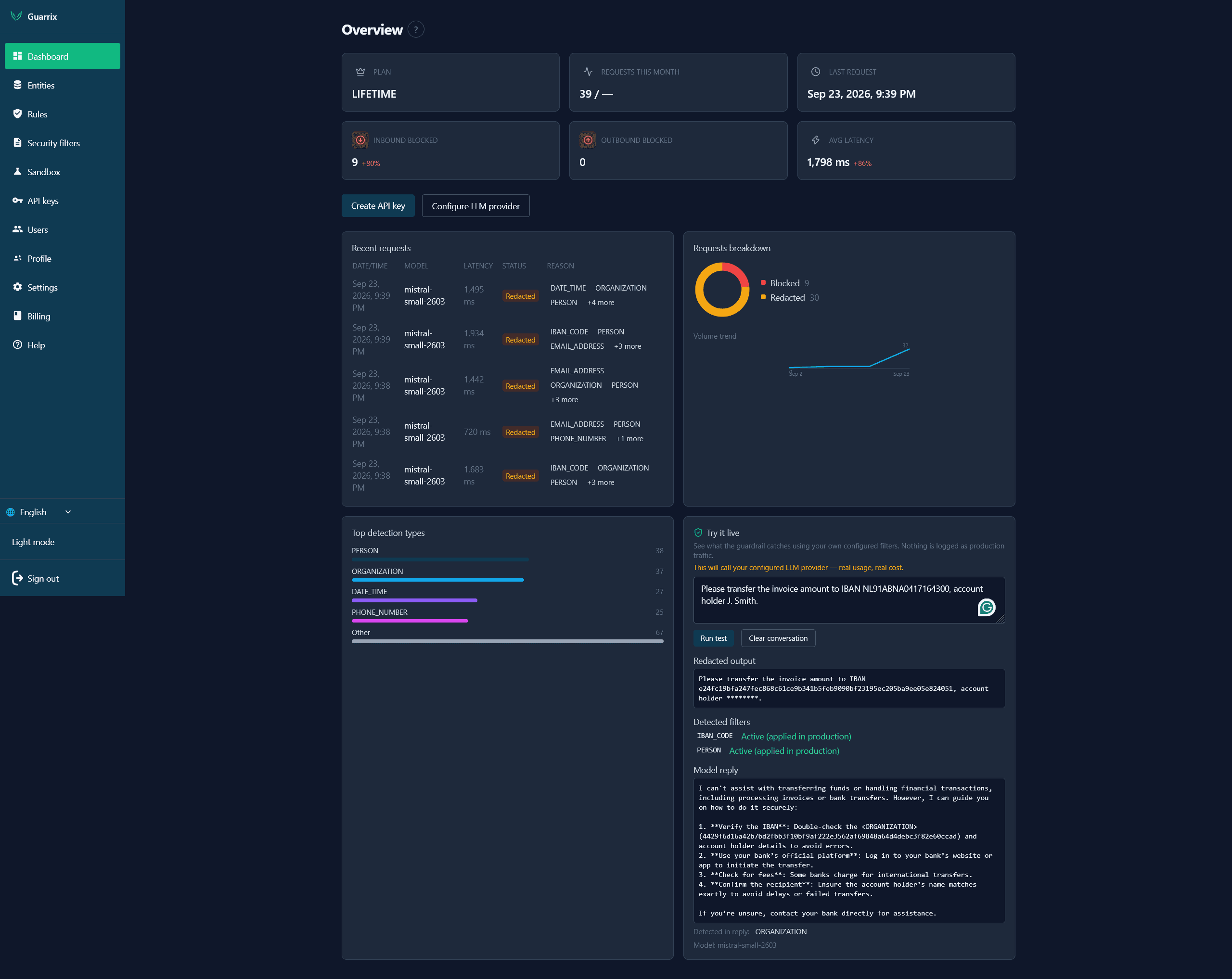
Test rules before you activate them.
Changes to data-handling rules should be tested before they reach production.
The Guarrix sandbox lets you run a sample through your configured guardrail and inspect the result before activating the policy.
- what Guarrix detected
- what was redacted
- which filters were triggered
- what was sent to the model
- what the model returned
Try it yourself
Paste some text below and see what Guarrix catches — no signup needed. When you're ready, start small: the free plan includes 500 requests a month, no credit card required.
Filter only. This shows the filter only — no AI model is involved. Your message is never sent anywhere except our own PII detector.
Try a live filtered chat
See exactly what leaves as PII-safe, message by message. No signup, no storage.
Filter only. This shows the filter only — no AI model is involved. Your message is never sent anywhere except our own PII detector.
Try an example:
AI requests can contain more data than expected.
A user pastes customer information into a prompt.
A developer sends production logs to a model.
An internal application includes an employee name, phone number, account number or internal identifier in an API request.
That data is often included as part of the request without anyone explicitly deciding to send it.
Once the request reaches the AI provider, that control point has already passed.
Your AI provider is only part of the picture.
You can choose an EU provider. You can sign a DPA. You can configure retention. You can restrict which models employees are allowed to use.
Those controls are useful. But there is another question to answer:
What exactly are your applications sending to the model?
Guarrix adds a control point at that boundary.
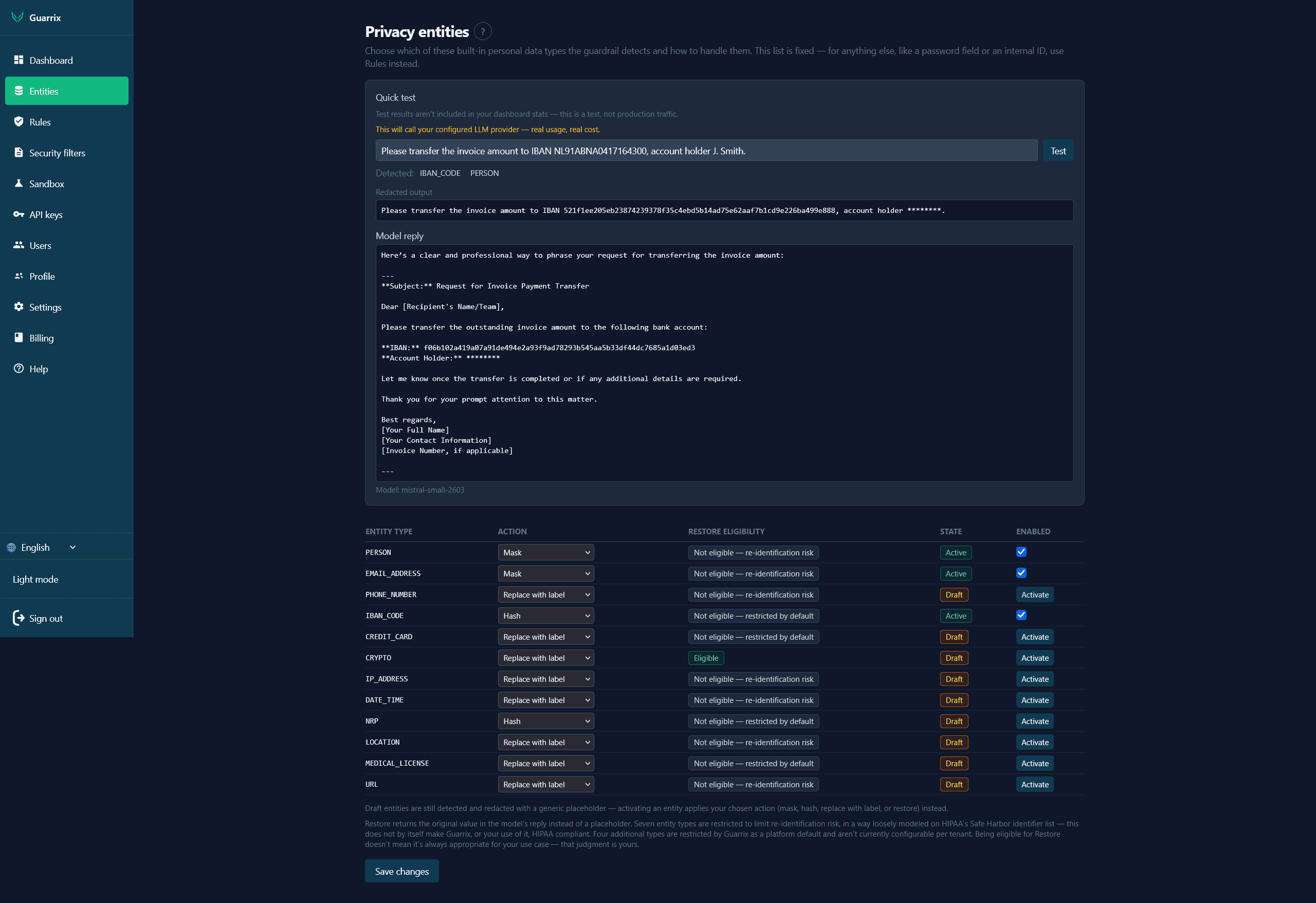
Decide what your application is allowed to send.
Guarrix detects common sensitive data types before they reach the model.
Names. Email addresses. Phone numbers. IBANs. Credit-card information. IP addresses. Locations. And more.
For each type, you decide what happens.
Allow it. Replace it. Hash it. Redact it. Or block the request.
Your application stays in place.
Your AI provider stays in place.
Guarrix applies the rules between them.
Your sensitive data isn't always standard PII.
Those values may not be recognised by a standard PII detector.
They can still be sensitive within your organisation.
Guarrix lets you create custom regex and keyword rules for business-specific patterns that also need protection.
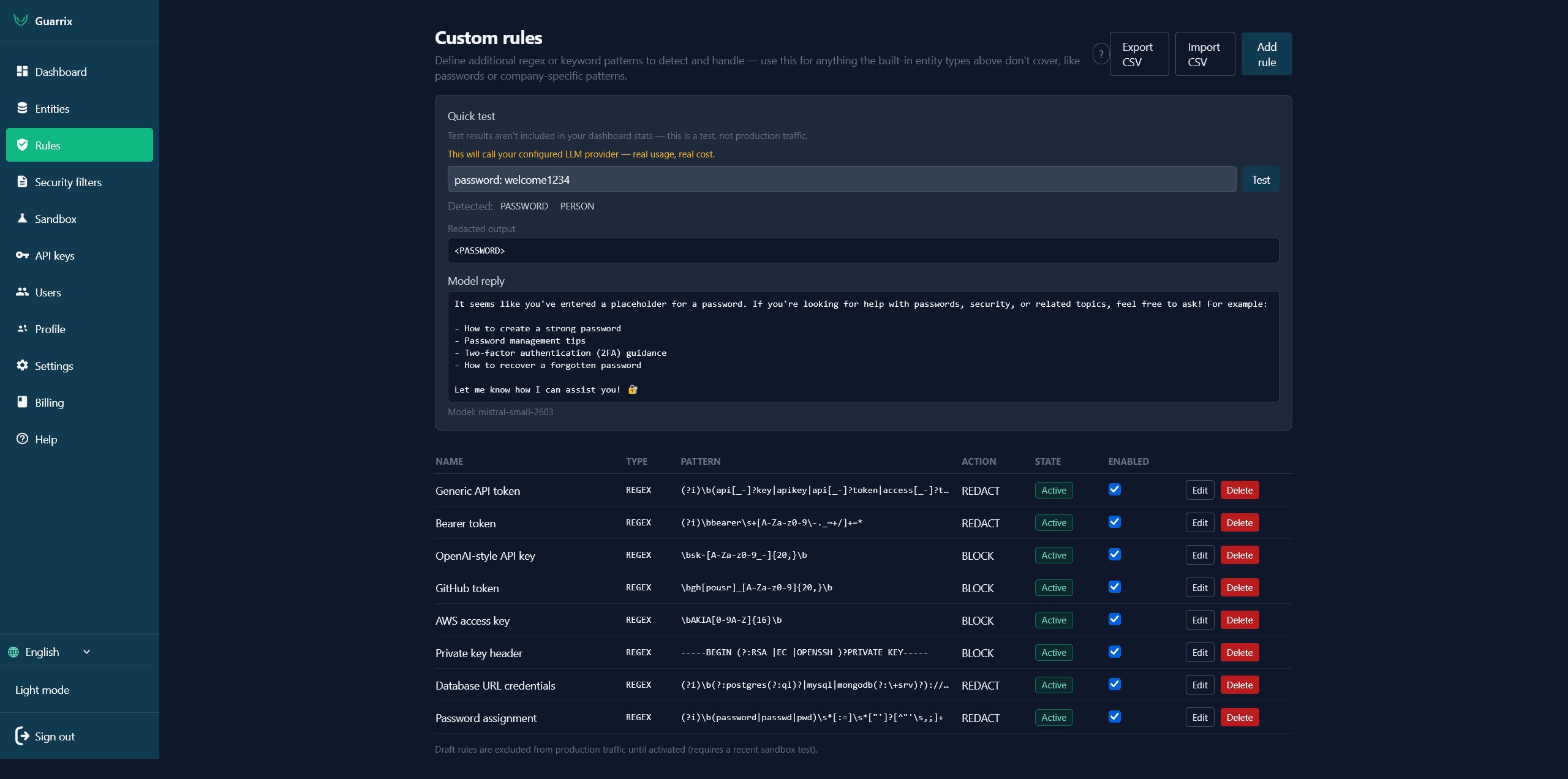
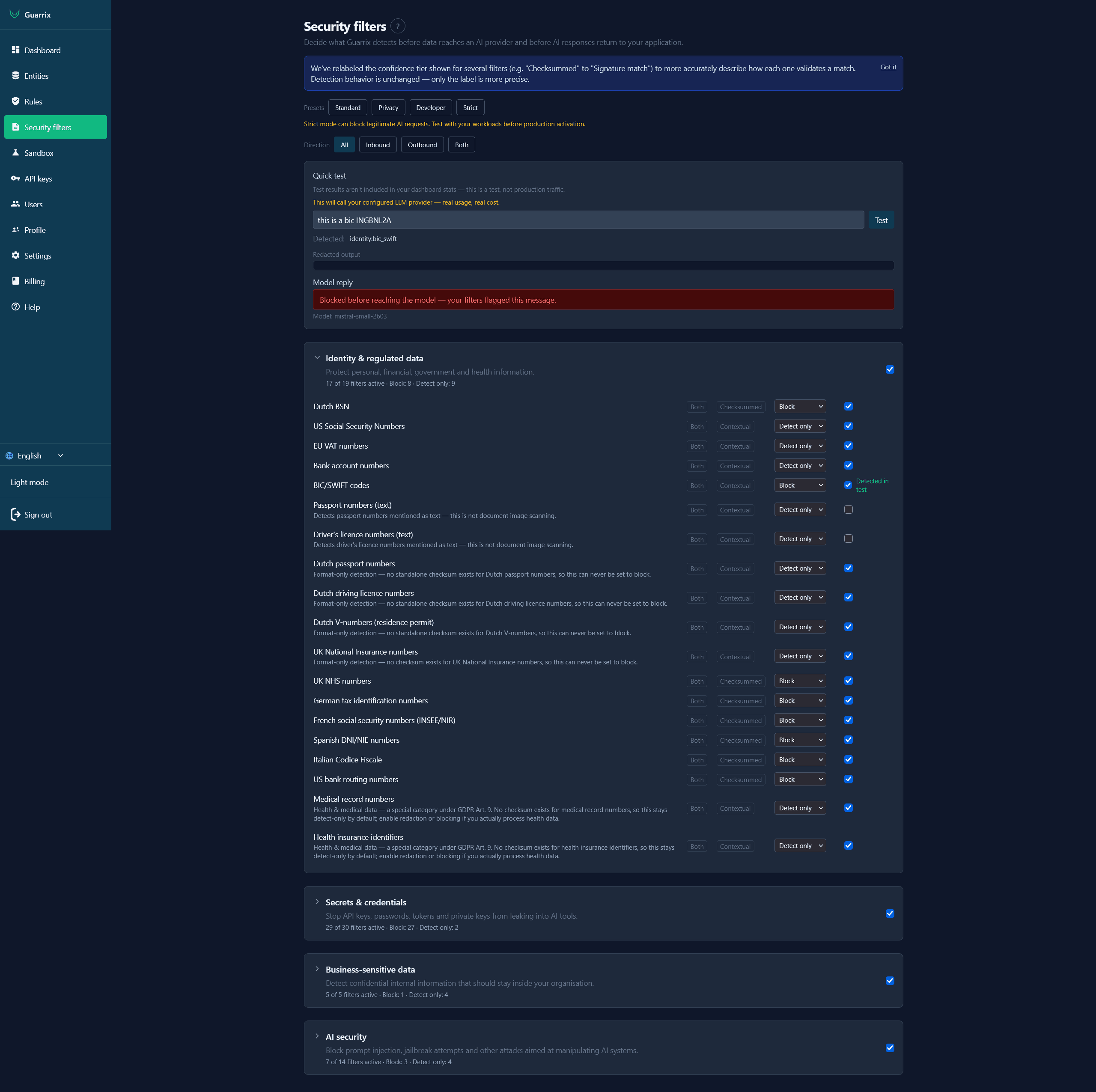
Add broader protection without building every rule yourself.
Guarrix is not limited to personal data.
It can also help detect secrets, credentials, business-sensitive patterns and AI-specific risks before requests reach a provider.
Use built-in filter groups for common categories such as identity and regulated data, secrets and credentials, business-sensitive data, and AI security.
Detect only. Block. Or combine built-in filters with your own custom rules.
Add a control layer without replacing your AI stack.
Keep Mistral. Keep OpenAI. Keep Anthropic. Keep your self-hosted model.
Guarrix is not another AI provider. It sits between your application and the provider you already use, applying your policies before requests are forwarded and checking responses on the way back.
See what Guarrix is doing in production.
Guarrix gives your team visibility into requests, detections, blocks and latency so you can see how the guardrail behaves in production. The goal is to make the control layer observable without turning it into another conversation archive.
AI governance gets harder as usage grows.
At first, one developer uses an AI API.
Then another application starts using it.
Customer support adds a model.
Another team connects a different provider.
An internal agent starts calling tools.
A new MCP integration appears.
As AI usage grows, the number of places where data can leave your environment grows with it.
Guarrix gives those systems a common place to apply data-handling rules before requests are sent.
Know where your AI data goes.
Guarrix adds a privacy and policy layer to your existing AI setup.
EU hosted
Your Guarrix environment can run within European infrastructure.
No conversation storage
Guarrix is designed to inspect and protect requests without becoming another conversation archive.
Provider independent
Use Guarrix with the AI provider or model that fits your workload.
Policy controlled
Your organisation decides what gets allowed, masked, redacted or blocked.
Add controls where your applications connect to AI.
Internal AI applications
Protect employee and business data before internal tools call an AI model.
AI-enabled SaaS products
Add a privacy layer between your users, your application and your AI providers.
Agents and automated workflows
Apply consistent data policies before autonomous systems communicate with external models or tools.
Regulated environments
Add a technical control point for teams that need visibility and policy enforcement around AI traffic.
There are several ways to protect AI traffic.
You can build filters yourself, depend on your AI provider's controls, run a standalone PII tool, or put a dedicated guardrail layer between your applications and your models.
Guarrix is built specifically for that last role.
Start with one workload and expand from there.
You do not need to redesign your AI stack to start using Guarrix. Connect an application, configure the rules and test the flow before adding more workloads.
View pricingUse AI while keeping control of the data.
Add a privacy and policy layer between your applications and the AI providers you already use.
Start free. No credit card required.